
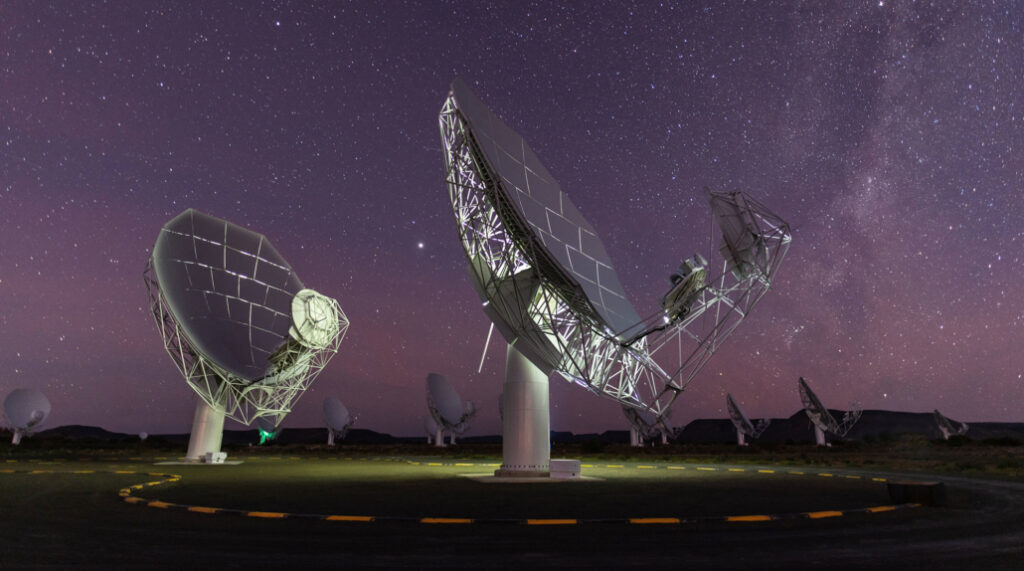
As Elon Musk’s Starlink moves toward entry into the South African market, astronomers are increasingly concerned about the impact of its low-Earth orbit LEO satellites on radio astronomy, particularly at the Square Kilometre Array SKA-Mid located in the Karoo region of the Northern Cape.
The SKA, one of the most powerful radio telescopes on the planet and a joint project with Australia, operates within a radio frequency band of 350 MegaHertz(MHz) to 15.4 GigaHertz(GHz).
These frequencies, crucial for observing faint cosmic signals, overlap with the downlink bands of many satellite services, including Starlink.
It’s like shining a spotlight into someone’s eyes, it overwhelms our ability to detect the faint radio signals coming from space, explained Federico Di Vruno, co-chair of the IAU Centre for the Protection of the Dark and Quiet Sky.
To safeguard SKA observations, Di Vruno noted that both the SKA Observatory and the South African Radio Astronomy Observatory SARAO are urging regulators to include specific licensing requirements.
These would either require Starlink to steer satellite beams away from SKA receivers or pause transmissions briefly during sensitive observations.
In February 2025, South Africa delivered a statement to the 62nd session of UNOOSA’s Scientific and Technical Subcommittee under the “Dark and Quiet Skies” agenda.
Presented by Itumeleng Makoloi, Director of Space Systems at the Department of Science and Innovation, the statement emphasised the country’s astronomical strengths, hosting the Southern African Large Telescope SALT, the largest single optical telescope in the Southern Hemisphere, alongside the world class MeerKAT radio telescope.
Makoloi noted that satellites in low Earth orbit LEO pose different challenges for astronomy than those in higher orbits.
Their swift passage through telescope focal planes causes their light to spread over a larger area, reducing per-pixel brightness, making them less disruptive than stationary geostationary satellites.
However, the large quantity of LEO satellites required for global coverage creates a complex issue while individually dimmer, their numbers increase the likelihood of interference.
Balancing orbital height, brightness, and constellation density is therefore critical in assessing their overall impact on long-exposure astronomical observations.
Source:https://spaceinafrica.com/2025/06/17/astronomers-raise-concerns-over-starlinks-impact-on-south-africas-telescope/