
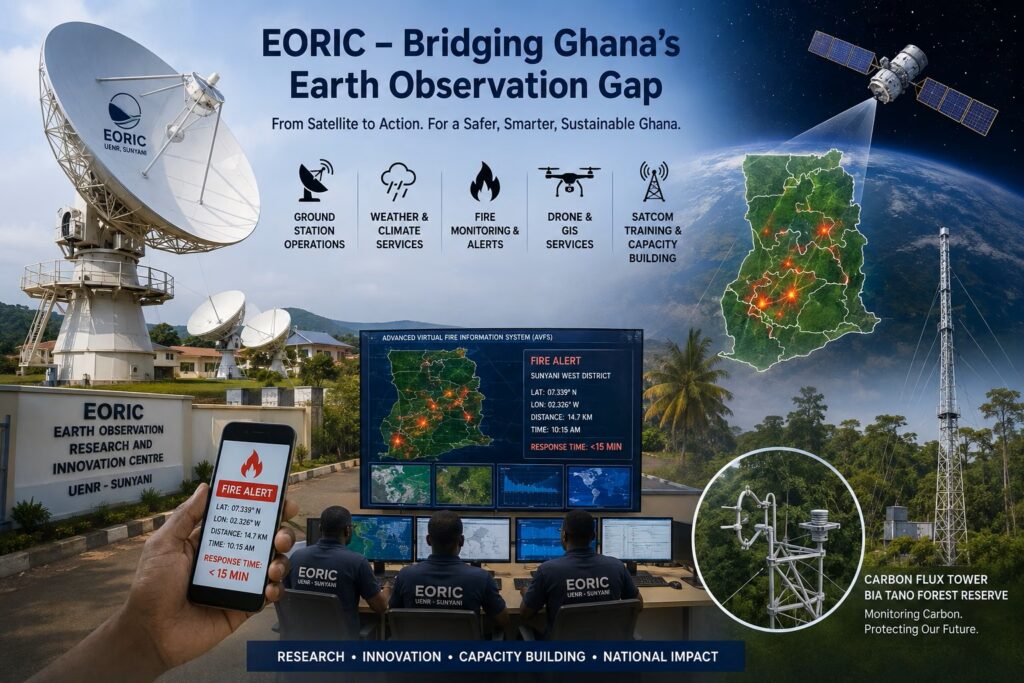
Every dry season, wildfires burn through tens of thousands of hectares across Ghana’s northern and middle belt regions. The Ghana National Fire Service and NADMO typically receive alerts after fires have already moved beyond containable perimeters. As a result, Ghana loses an estimated 2% of its forest cover each year, a figure derived from satellite-based assessments that most national institutions cannot produce domestically.
Flooding across the Volta Basin has worsened, and the unpredictability of rainfall continues to disrupt agricultural planning in a country where farming employs roughly 40% of the workforce.
Running through each of these problems is the same structural gap: Ghana has long depended on foreign institutions to acquire, process, and interpret the satellite data required to understand and respond to its own environmental conditions.
That dependency is not just about hardware. Ghana lacks enough trained personnel and domestic ground infrastructure to receive satellite data over its territory, process it locally, and route it to institutions that can act on it. Satellites pass over Ghana continuously. What has been missing is the national capacity to use what they generate.
The fact that EORIC operates within a public university matters to its long-term functioning. UENR’s mandate in energy and natural resources directly matches EORIC’s technical scope.
The university structure creates a direct line from training to applied research to operational deployment, and it means EORIC’s physical infrastructure is a national asset, not tied to a single client or contract cycle.
Ghana faces concurrent pressures on its forests, agricultural sector, and connectivity gap. Whether the country can address any of these using satellite-derived data depends on whether it has domestic institutions capable of receiving, processing, and applying it.
EORIC is currently one of the most concrete answers Ghana has to that question.
Source: https://spaceinafrica.com/2026/05/18/the-university-centre-at-the-forefront-of-bridging-ghanas-earth-observation-gap/